


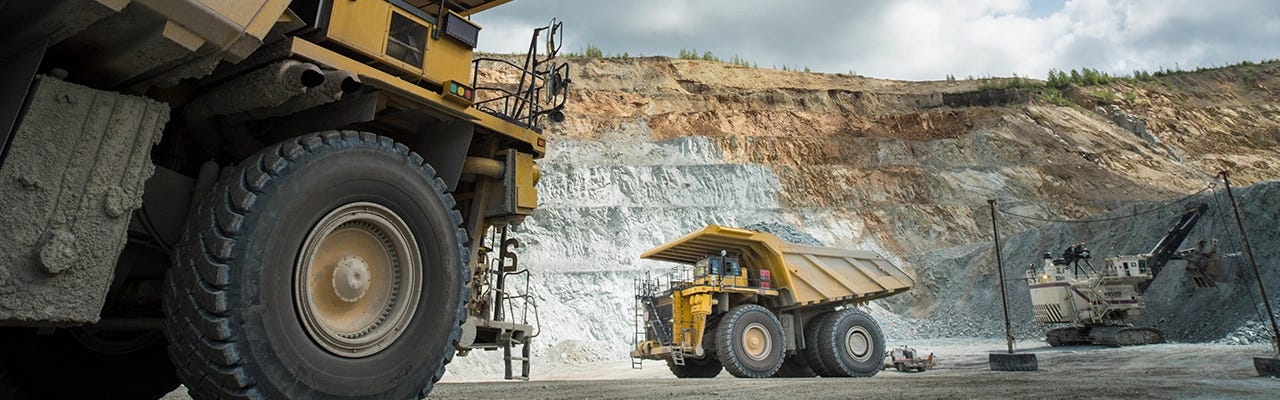
Back in February, mining giant Anglo-American announced that it was selling its Brazilian ferronickel business for half a billion dollars. But the buyer - the Chinese-Australian miner MMG - raised a few eyebrows in Brussels.
Global strategic competition, especially with China, has made access to minerals and alloys a policy priority for the EU. Ferronickel is a critical input for the manufacture of stainless steel, which in turn is used in defence platforms like airframes, naval vessels and weapon systems; as well as critical infrastructure, chemical plants and energy systems.
The fear is that MMG could divert sales away from EU customers if things get hairy, prioritising countries that might be hostile to Europe. Even assurances that MMG would enter into binding, decades-long supply agreements with EU companies wasn’t enough to calm the Berlaymont.
The deal now hangs by a thread in what’s known as phase two of the EU’s merger control process (for the uninitiated, if you need more than one phase to pass merger control, you have a problem). And without Brussels’ blessing, the sale can’t happen.
What changed?
People I speak to say that this deal would have sailed through in phase one before Vladimir Putin decided that a full scale invasion of Ukraine was a good way to spend his declining years.
Back when we thought globalisation was an unstoppable civilising force, merger control focused primarily on whether a deal would significantly impede competition in Europe in terms of price, output, choice and innovation in overlapping or vertically linked markets.
In basic industrial inputs like steelmaking alloys and metals, concerns would often center on price effects, consolidation and potential unilateral or coordinated effects. Strategic supply security was not a central enforcement driver on its own.
Plus ça change. Commissioner Teresa Ribera, whose portfolio has competition at its heart, made clear in her statement that this was all about resilience.
“Ferronickel is a key input for European producers to manufacture high-quality, low-emission stainless steel at competitive prices, which is critical for many sectors” she said in her press release. “Our investigation aims to verify whether this concentration could jeopardise continued and reliable access in Europe”.
So just like that, the goalposts moved.
Sometime in Spring, the Commission is expected to update its merger control guidelines because “transformational changes” have altered competitive dynamics. Officials are walking a tightrope. For years they have been taught that competition enforcement should be pure of heart and focus on economics.
The geopolitics are also tricky. On the one hand, the Commission talks about the need to consider resilience when looking at mergers, foreign investments and the like; on the other, they refuse to single out which jurisdictions threaten Europe’s resilience. That was awkward when it was just China. Add the US into the mix and it becomes almost unbearable.
Practically, this pulls merger control - kicking and screaming - closer to industrial policy. In a rearmament context, that matters because defence markets and supply chains (think electronics, propulsion, space, cyber, sensors, secure communications) often have narrow supplier bases, long qualification cycles, state-shaped demand and strategic vulnerabilities that do not show up neatly in consumer price effects.
And merger control is just one tool
DG COMP is often thought of as where Brussels’ real power lies, and in recent years it’s developed a new toy to play with that will become more and more relevant to defence planners.
The Foreign Subsidy Regulation is the EU’s answer to a structural gap: EU state aid rules discipline Member States, but not foreign governments subsidising companies competing in the internal market. So if you’re a state backed Chinese company and you want to access EU public procurement markets, or a Middle Eastern sovereign wealth fund looking to buy up German chemicals businesses, the idea is that FSR will stop you using your chequebook to muscle out European competitors.
Both of these examples have actually happened: China’s state railway company is being investigated for its role in the construction of a railway line in Lisbon, and Abu Dhabi’s sovereign wealth fund had to guarantee it would let other EU companies use Covestro’s IP in order to get that deal approved.
The quid-pro-quo logic is even more explicit. If your State money distorts the internal market, but you can convince the Commission that there are wider policy benefits to letting you do so, they can let the deal go through anyway. This is known as the “balancing test”. And the Regulation itself requires the Commission to focus on strategic and sensitive industries.
The relevance to resilience planning is straightforward and obvious. Resilience depends on procurement and industrial scaling, industrial scaling depends on capital, capital can be state-backed, and state-backed capital can buy market position quickly. The FSR lets Brussels say: “We want investment, but not investment that distorts competition through subsidy strategies that create dependency or hollow out domestic capability.”
But what about old fashioned FDI screening?
If merger control and the FSR are about market structure and distortions, FDI screening is explicitly about security and public order. But policy reality is that the same transactions can raise all three concerns simultaneously.
In December, the Council reached an agreement with the European Parliament to improve FDI screening, as part of initiatives announced in the Commission’s 2024 economic security package. The 2019 Regulation it replaced was deliberately modest. It created an information-sharing mechanism, non-binding Commission opinions and near-total deference to Member States.
While the new agreement stops short of mandating screening for all investments, it establishes a de facto obligation to screen transactions in a defined list of sensitive areas (defence, dual-use, critical infrastructure, advanced technologies, critical inputs), as well as supply-chain chokepoints: components, materials, software, and enabling services.
New objectives, but well-tested tools
Europe’s rearmament push has mostly been discussed in the language of budgets, production lines, joint procurement and “security of supply”. But the EU’s resilience planning is also being built through the regulatory architecture the Commission knows best. Resilience planning is not only about spending more. It is about controlling vulnerability: ownership, subsidies, dependencies, and bottlenecks. Merger control, the FSR and FDI screening are becoming the EU’s administrative toolkit for that control.
The convergence between competition and defence priorities matters because it changes what counts as “risk” in transactions. The question is no longer just whether a deal raises prices or reduces output. It is increasingly whether it shifts control over critical capabilities, supply chains, data or industrial capacity in ways that make Europe dependent on actors whose interests are not, or might not be, aligned with Europe’s.