


iRobot’s collapse has got the Competition bubble on LinkedIn quite agitated. There’s a lot to get our teeth into on whether the right call was made both legally and strategically.
But that’s for other folk to worry about – all I’ll say is “the target needed an exit for financial reasons” is never going to convince enforcers to ignore clear risks to consumers, now or in the future.
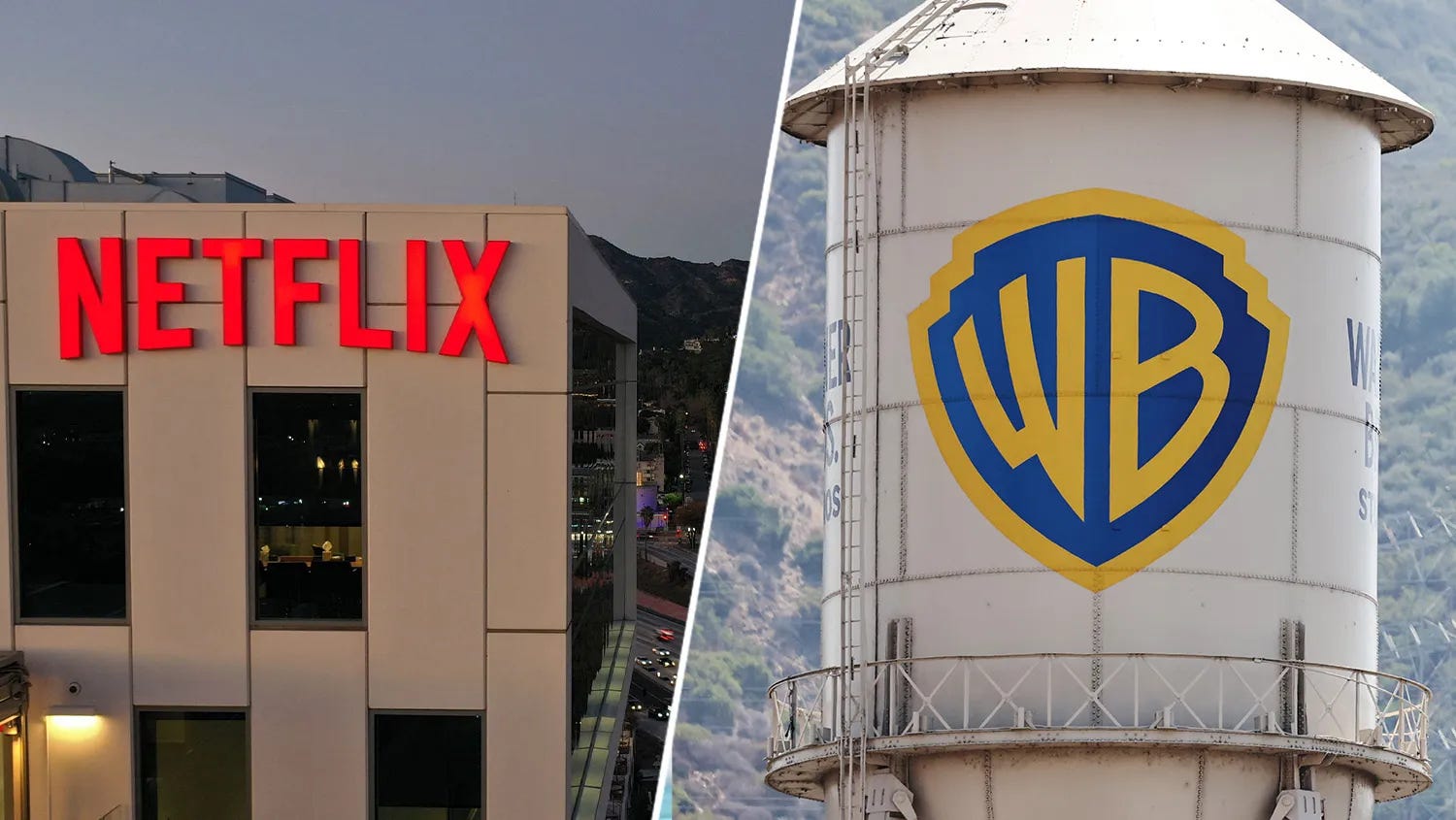
What we’re interested in here is what it might mean for the blockbuster deal of 2026: the acquisition of Warner Brothers by either Paramount or Netflix.
Part of Paramount’s pitch to WBD shareholders is “running the merger control gauntlet will be easier with us”. Netflix had to offer a $5.8bn break clause because of precisely this risk. Most of the public commentary has centred on how this relates to US antitrust risk, but there’s a European component to it too.
A brief primer…
The Commission never formally prohibited Amazon/iRobot. It didn’t need to. A Phase II investigation plus a Statement of Objections (SO) was enough to make the deal commercially pointless, and the parties walked away. That matters because the Commission has effectively shown it can “kill” deals through credible foreclosure theories – bearing its teeth via a strongly worded SO – long before litigation risk is tested in court.
The foreclosure theory in Amazon/iRobot was not subtle. The Commission’s SO framed the risk as Amazon using control of its marketplace to reduce visibility and/or access for rival robot vacuum brands, strengthening Amazon’s broader platform position (including in related advertising and data markets).
In layman’s terms: if Amazon is where people buy robot hoovers and they own the dominant robot hoover, not only will they stop customers seeing other robot hoovers, but they also learn way more about how to make better robot hoovers.
A lawyer who proofread this insisted that I reference the non-horizontal guidance where this comes from. Fine, here’s point 18 of that guidance in full, just for the true merger control nerds:
“Non-coordinated effects may principally arise when non-horizontal mergers give rise to foreclosure. In this document, the term ‘foreclosure’ will be used to describe any instance where actual or potential rivals’ access to supplies or markets is hampered or eliminated as a result of the merger, thereby reducing these companies’ ability and/or incentive to compete.”
Translating that from lawyer points at the underlying enforcement signs at issue here: where a buyer controls a key route to market, the Commission will assume it can – and will – tilt the field after closing. The burden of proof is with the parties from there on out.
What’s this got to do with Warner Brothers?
The Commission’s Amazon/iRobot approach has put “control of access” front and centre: ranking, discovery, shelf space, and monetisation levers are treated as foreclosure tools even when they’re hard to observe and easy to rationalise as “quality improvements”. If there’s one thing Netflix does, it’s control access to content. And WBD makes a lot of that content, competing with other studios for juicy contracts from streamers.
Put bluntly, what happens when a dominant distribution layer combines with an important content/input layer?
The Commission’s lens will not be “does this raise the price of a subscription tomorrow?” It will be: “does the merged firm gain the ability and incentive to foreclose rival distributors and rival content suppliers over time—through content licensing, windowing, exclusivity, bundling, advertising stack integration, and discovery/placement on the interfaces that matter”.
For our legal readers, here’s point 30 of the guidance:
“Two forms of foreclosure can be distinguished. The first is where the merger is likely to raise the costs of downstream rivals by restricting their access to an important input (input foreclosure). The second is where the merger is likely to foreclose upstream rivals by restricting their access to a sufficient customer base (customer foreclosure)”
Well…yeah. Both of those things. If Netflix and, say, Disney +, wanted the same show, who’d you think gets it?
When Netflix gets it and learns something valuable about how viewers interact with it, WBD will benefit from those learnings. The benefits of additional data was specifically mentioned by the Commission when it waxed lyrical on iRobot. If it applies to hoovers, it sure as hell applies to content.
But but but…
The Commission’s 2021 merger decision in Discovery/WarnerMedia (M.10343) is a key reference point because it shows how Brussels historically analysed the audio-visual value chain: upstream content production, wholesale supply of channels, retail supply of AV services, plus advertising.
The decision is a Phase I non-opposition clearance and explicitly frames horizontal, vertical and conglomerate theories (including foreclosure) but ultimately finds no significant impediment to effective competition.
How much comfort should this give us? Not much, frankly. The competitive context has moved: streaming has consolidated, advertising models have converged, and “distribution power” now often sits with a small number of interfaces (streamers, device OSs, app stores, smart-TV platforms).
What will be decisive is how effectively Netflix frames its competitors: is it Disney + and Amazon Prime, or is it YouTube and TikTok?
Bottom line
There’s one thing we haven’t really addressed here: whether the Commission might actively prefer Netflix to Paramount for political reasons. I’ll look at those kinds of issues in a future article, but I’m sure there are people way up there in the hierarchy that secretly want to stop yet another major media conglomerate falling to a devotee of the MAGA world.
But in traditional competition policy terms, Amazon/iRobot is the Commission telling the market: if you control access, vertical deals will be analysed as if you intend to use that control unless you can prove otherwise with credible evidence and enforceable commitments.
If a Netflix/WBD-type scenario is evaluated through that lens, it spells trouble, even if the “asset” is content rather than a vacuum cleaner. And the Commission has already shown it can achieve the practical effect of blocking a deal without ever issuing a prohibition decision.