


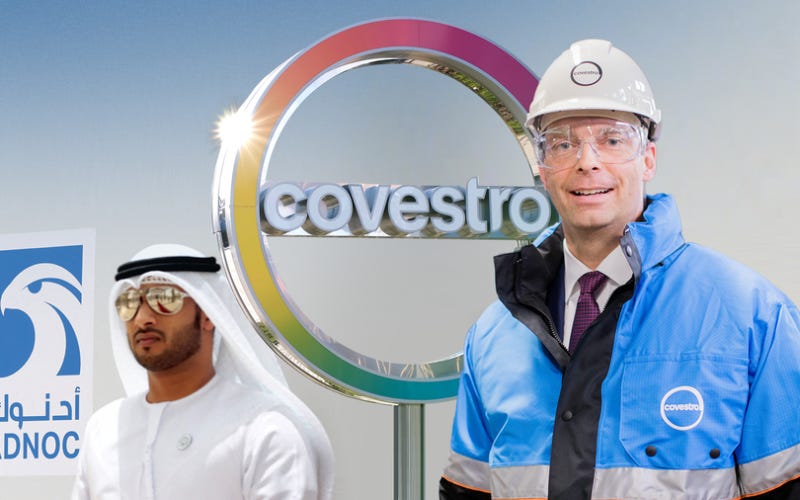
Competition decisions are not generally written with the reader’s entertainment in mind. They tend to resemble the bastard love child of a tax return and the instruction manual for assembling Chinese-made flat pack furniture.
But the European Commission’s decision on ADNOC’s acquisition of Covestro is one of the first serious tests of the Foreign Subsidies Regulation (FSR). If one squints slightly, it tells us quite a lot about how future cases may play out. Possibly including a certain transaction involving Electronic Arts. So, I reasoned, I’d probably have to read it.
To understand the story, one must remember how the FSR investigation unfolds. The Commission essentially works through a sequence of questions:
Was there a foreign financial contribution (FFC)?
Did it confer an advantage?
Did that advantage distort the acquisition process?
Could it distort competition after the deal?
Can remedies neutralise the distortion?
Simple enough in theory.
In practice, however, FSR is a legal framework applied to fundamentally political questions. Traditional merger control is supposed to be technocratic. FSR is the EU politely applying rules-based makeup to what is, at heart, a geopolitical pig.
And on top of that, there’s one procedural point worth remembering: there is no such thing as Phase I remedies. If you need commitments, you are going to Phase II. Bring snacks.
Chapter One: was this a foreign financial contribution?
One method I’ve found to make reading decisions more enjoyable is to have your chatbot of choice reproduce them in the style of a famous author. Let us begin in the style of Jane Austen, where polite scepticism is always delivered with perfect manners.
“ADNOC, wishing to preserve its reputation as a commercially minded enterprise, argued that its operations were conducted independently, according to ordinary business judgement. Though owned by the Emirate, it suggested that its financial decisions were not dictated by government instruction.
The Commission regarded this explanation with respectful but evident scepticism. Ownership, after all, has a habit of revealing influence.”
The Commission’s reasoning is not complicated. ADNOC is wholly owned by the Emirate of Abu Dhabi, and its governance structure remains closely tied to public authorities responsible for strategic national enterprises.
ADNOC argues that there’s sufficient distance between it and the BidCo, XRG, to make any unlimited guarantee a moot point: but the Commission were having none of it. They almost whimsically reproduce ADNOC’s board members in full, dryly pointing out that most of its members hold ministerial positions.
The same structural reality applies to other sovereign investment vehicles. Saudi Arabia’s Public Investment Fund, for example, looks remarkably similar when one examines the board.
Clever corporate structuring does not hide sovereign ownership. If the state owns the company, the Commission will treat the money as state-backed.
Chapter Two: Did the advantage distort the acquisition process?
At this point, the temptation to overuse literary assistance becomes irresistible. So imagine the Commission’s analysis delivered as a Shakespearean soliloquy:
“Did foreign gold incline the courting field?
The offer — two-and-sixty coins a share —
By some accounts stands higher than the norm.
Yet comes the answer swift: the price is fair,
The market’s arts and reckonings approve it.
And more: no rival suitor rose to bid.
But here the matter turns more subtle still.
For silence proves not innocence in trade.
A bidder flush with sovereign favour
May chill the courage of competing men.
What merchant enters lists already lost?”
The Commission concluded that the offer price was on the high side. But it also explored a more interesting possibility: the chilling effect. If a bidder is backed by effectively unlimited sovereign resources, rival bidders may simply decide not to bother. Why start a bidding war you can’t win?
This is where the Covestro case becomes interesting for future deals. ADNOC offered roughly a 50% premium to the market value of the unaffected share price before news of the negotiations broke. In the EA transaction, the figure circulating is closer to 25%.
Chapter Three: What happens after the acquisition?
Now let us switch tone and imagine the Commission’s internal debate written by P.G. Wodehouse.
One of the Commission’s more thoughtful officials — a chap who had spent many years contemplating the curious habits of international capital — eventually leaned back in his chair and observed that perhaps they had been looking at the matter from the wrong end.
The more pressing question, he said, was what would happen after the acquisition.
The documents before the Commission indicated that the merged company intended to pursue a rather energetic programme of investment. New facilities. Expanded production. Money directed toward promising technologies — particularly those involving sustainable materials.
All of which was perfectly admirable. The Commission has always been fond of companies investing in useful things.
But the official gently pointed out — in the careful manner of a man replacing a teacup exactly on its saucer — that if those investments were funded by advantages derived from a foreign state, the resulting company might develop a certain spring in its step that competitors would find difficult to match.
The Commission is effectively worrying about over-investment in a European industrial champion to the detriment of its competitors. Which makes sense when the company in question produces materials that align neatly with EU industrial and climate policy. Whether that logic translates neatly to an American publisher of video games is, of course, another matter entirely.
Chapter Four: remedies, or how to pretend everything is fine
For this final act we turn to Douglas Adams.
“At a certain point in regulatory investigations — and this happens with remarkable consistency across the European Union — the discussion stops being about what went wrong and starts being about how everyone might pretend, in a perfectly respectable and legally robust way, that nothing too terrible will happen in the future.”
Two remedies were central.
First, the Commission addressed the possibility that ADNOC could benefit from an implicit unlimited state guarantee. The fix they employed the last time ADNOC bought an important European telecoms business involved ensuring that normal bankruptcy rules would apply, thereby removing the perception that losses would ultimately be socialised by the Emirate. In the end, this is a copy/paste job.
But second came a more interesting condition involving Covestro’s intellectual property. Covestro has an impressive portfolio of patents in sustainable materials and lower-carbon industrial processes. With ADNOC’s financial backing, there was every reason to believe the company might become even better at inventing things.
Which is excellent news for science, but possibly less excellent news for competitors if those inventions were locked behind a door.
The Commission therefore proposed a compromise. Certain technologies would be licensed to third parties on fair, reasonable and market-based terms. Lists of patents would be published, and dispute mechanisms created.
This is designed to deal with the possibility that the unlimited guarantee perpetuates an ongoing market distortion
, and keeps what the Commission saw as critical technological know-how in the control of European-owned companies.
Time will tell whether this is at all effective. But what it does show is that FSR lets case handlers in the Madou Tower get creative with structural remedies. Perhaps EA will need to get comfortable with that concept too.
The Political Interlude
And now we arrive at the slightly awkward part of the story. At one point during the investigation — after repeated requests for information in both Phase I and Phase II — ADNOC appears to have lost patience.
“We are deeply disappointed by today’s decision” ADNOC’s spokesperson said, upon learning that the case would be moved into phase two.
“The Commission’s demands have strayed far beyond what is reasonable or relevant to this transaction, crossing into areas that are both disproportionate and invasive. While we remain committed to pursuing a constructive path forward, the continuation of such an approach raises serious questions about the viability of this investment”.
This seems to be a pretty straightforward “do you want our money or not?” statement. And, as it turns out, they did.
In the decision itself, one can almost see the moment when this occurred. The tone of the recitals shifts noticeably, and agreement on remedies suddenly becomes remarkably smooth.
The explanation is widely understood in Brussels. The case moved above the level of DG COMP. Senior political conversations followed: a call between Teresa Ribera and Sultan Al Jaber (ADNOC’s CEO), a meeting between Ursula von der Leyen and Al Jaber on the sidelines of the UN General Assembly in New York, and discussions with the German government. And then suddenly all was well.
Which brings us back to the broader point. The FSR is not traditional merger control: it’s a political process dressed in legal language. Lipstick. Pig. You get the idea.
And that matters if — hypothetically — a future case involved Saudi capital, American assets, a left wing Spanish Commissioner and the occasional appearance of figures like Jared Kushner. If such a deal ever reached Phase II, one suspects the literary inspiration might move away from Jane Austen entirely.
Something closer to Game of Thrones might be more appropriate.